
In 2014 University College London tested the survival of specific commercial probiotic formulations in their transit through the gut (1).
It is to be noted that the probiotics were directly and harshly exposed to simulated gastric fluids, which would be the worst case scenario and the main finding of the study was that probiotic consumption was best on an empty stomach (2).
Commercial probiotics investigated in the 2014 study were as follows (1):
| Product | Form | Probiotic strains | Volume or weight measured per content or dose | Claimed culture quantity | Dosage/ admin instructions |
| Actimel | Liquid (Dairybased) | L. casei DN 114 001 Also, L. bulgaricus and Streptococcus thermophilus | 100 ml | 10 billion per 100 ml | One bottle per day as part of breakfast |
| Align | Solid (Capsule) | B. infantis 35624 | 0.174 g | 1 billion per capsule | One capsule per day |
| Biobalance support | Solid (Capsule) | B. bifidum, L. acidophilus, and B. Lactis | 0.300 g | 12.5 billion per capsule | Capsules are to be taken once daily with liquid |
| Bio-kult | Solid (Capsule) | Bacillus subtilis PXN21, Bifidobacterium spp (B.bifidum PXN23, B. breve PXN25, B. infantis PXN27), Lactobacillus spp. (L. acidophilus PXN3, L. delbrueckii spp.bulgaricus PXN39, L. casei PXN37, L. plantarum PXN47, L. rhamnosus PXN54, L. helveticus PXN45, L. salivarius PXN57), Lactococcus lactis spp. Lactis PXN63, Streptococcus thermophilus PXN66. | 0.171 g | 2 billion per capsule | One or two capsules, once or twice daily. Capsule can be opened and the contents can be sprinkled on food, taken in a drink or swallowed whole. |
| Probio 7 | Solid (Capsule) | L. casei, L. rhamnosus, L. plantarum, L. acidophilus, Streptococcus thermophilus, B. bifidum, B. breve and B. longum. | 0.439 g | 10 billion per capsule | One capsule per day. Capsule should be swallowed whole |
| Symprove | Liquid (Nondairy, water-based) | L. rhamnosus, L. planatarum, L. acidophilus, and Enterococcus faecium | 60mL taken from 500 Ml bottle | 10 billion per 50 ml | 1 ml per kilogram of bodyweight as a liquid drink to be taken prior to food in the morning |
| VSL#3 | Solid (powdered sachet) | Streptococcus thermophiles DSM 24731, B. breve DSM 24732, B. longum DSM 24736, B. infantis DSM 24737, L. acidophilus DSM 24735, L. plantarum DSM 24730, L. paracasei DSM 24733 and L. delbrueckii subsp. bulgaricus DSM 24734. | 4.447 g | 450 billion per sachet | One sachet, once or twice daily. Sachets can either be sprinkled on food or reconstituted with cold water or any nonfizzy drink and consumed. |
| Yakult | Liquid (Dairy based) | L. casei Shirota | 65 mL | 6.5 billion per 65 mL | One or two bottles per day |
The results are below:
- All liquid products contained equal to or more than the label claim.
- Freeze dried products contained lower viable content than the label claim.
- The liquid based products maintained greater viability when exposed to gastric fluid from pigs (fed state) than the freeze dried products with the exception of VSL#3.
- All products lost viable bacteria when exposed to gastric fluid. However, four products (Actimel, VSL3, Yakult and Symprove) maintained viable bacterial numbers for 10 mins and three (Actimel, VSL3 and Symprove) were viable for up to 90 mins. Following exposure to gastric fluid, the bacteria in the same three products were shown to grow in growth medium over 12h.
- The results suggest that these products are capable of delivering viable probiotic species to the gut and indicate that the best way to take them is in the fasted state (to minimise gastric emptying time).
A study reported in 2023 also analysed the microbial content and survivability of 21 commercial probiotic products available worldwide. The results regarding claimed CFUs (colony forming units) versus actual from the study are below:
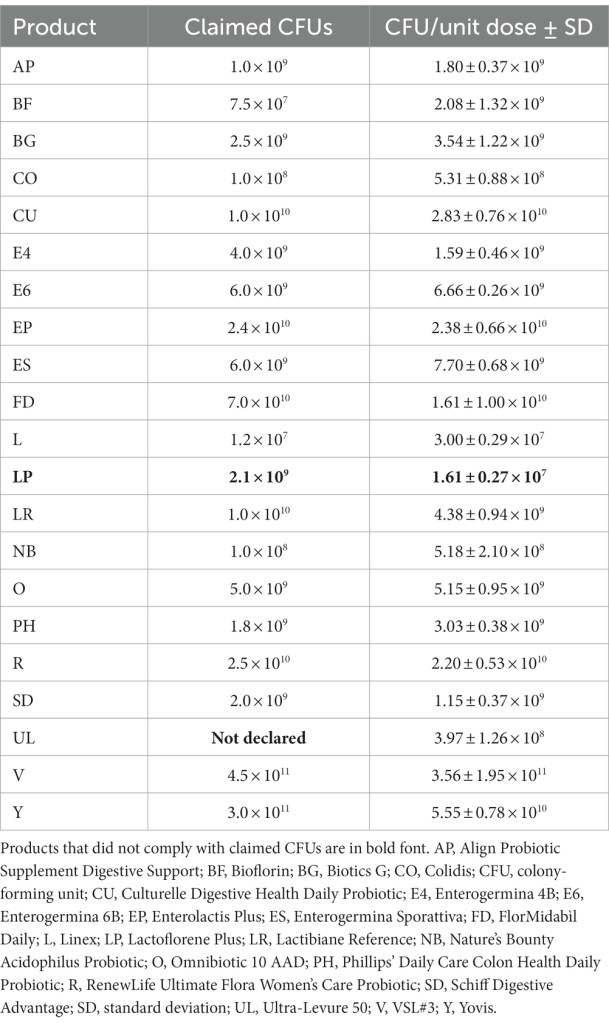
- The number and species of contained microorganisms matched label claims for most of the probiotics.
- Lactoflorene Plus had a lower number of viable microbes than the product label. Bioflorin contained a higher number than claimed.
- The Lactibiane Reference product did not correspond to the label regarding B. longum and L. helveticus strains. Omnibiotic did not contain B. longum which was on the label.
Below are the results of the survivability alongside the results of the claims regarding CFU and composition:
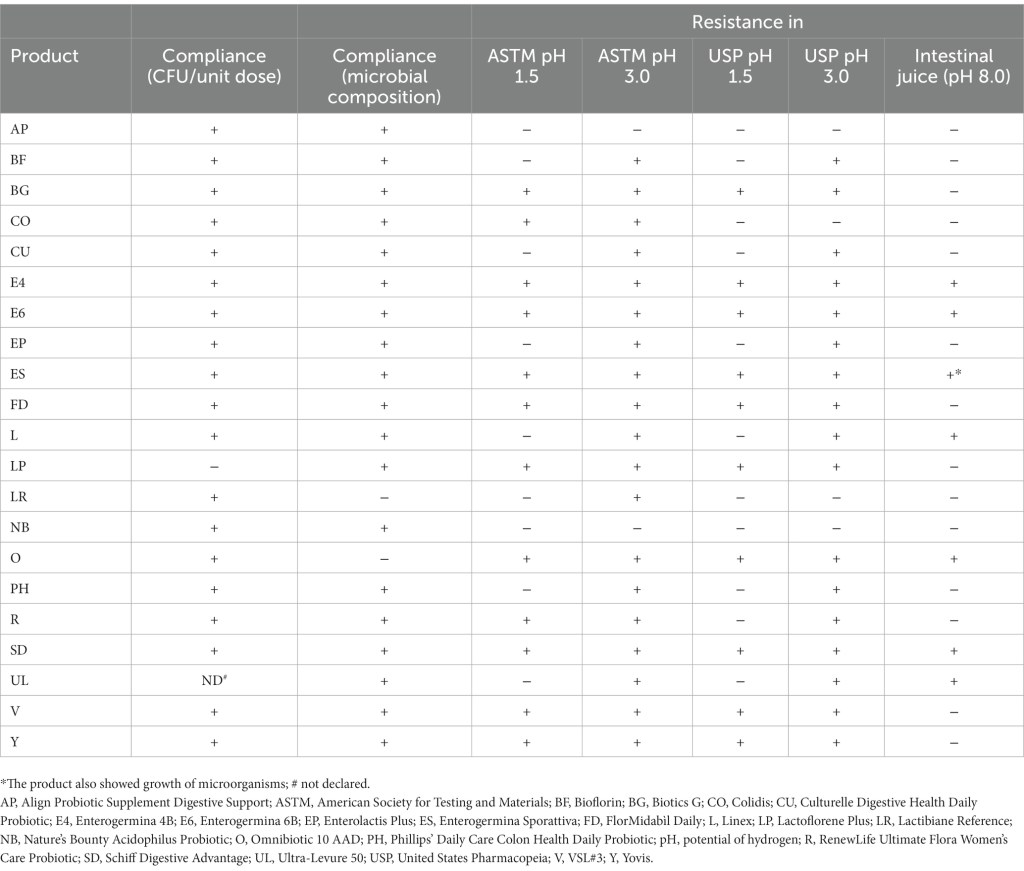
Regarding Align Probiotic and Bioflorin, it is to be noted that these had had their protective capsules removed for the study which may have impacted the results.
In a separate small study, 5 patients were administered Lactobacillus rhamnosus GG (ATCC 53103) and then underwent colonoscopy. The presence of Lactobacillus rhamnosus GG (ATCC 53103) was found in faecal samples and in the colonic biopsies from various large intestine locations in 4 out of 5 patients. One patient (suffering from ulcerative colitis diagnosed during the colonoscopy) had no Lactobacillus rhamnosus GG (ATCC 53103) detected in the biopsy samples. The fact that the bacteria was found in colonic biopsies suggests that the bacteria can adhere to the colon. (5)
Labdoor have content tested probiotics (6) and provided a ranking for them (7).
Further Reading And References
(6) Labdoor: New Laboratory Testing On Top-Selling Probiotics, May 11, 2017
 IBS Researcher