Table of Contents
Mediterranean Diet Benefits
Mediterranean Diet Food Guide
Fruits And Vegetables
Pulses
Wholegrains
Nuts
What If I Can’t Tolerate Dairy?
Free Course
Further Reading And References
Mediterranean Diet Benefits
One of the best diets for preserving the diversity of gut bacteria is the Mediterranean diet, which generally involves a greater consumption of vegetable rather than animal protein. Additionally, this diversity is promoted by the inclusion a variety of plant-based foods, rather than the exclusion of whole food groups through restrictive diets, which would have the opposite effect.
Greater adherence to a Mediterranean diet improves lipid profile (such as cholesterol), decreases inflammation, increases good bacteria in the gut such as Lactobacillus, Bifidobacterium, Eubacteria, Bacteroides, and Prevotella and decreases bad bacteria such as Clostridium. Consequently, there is an increase in healthful short-chain fatty acids which help to guard against many diseases.
Mediterranean Diet Food Guide
A suggested meal plan for the diet can be found here: (2)
The below diagram is also a fantastic guide as to what to consume and how often on the Mediterranean diet (3):
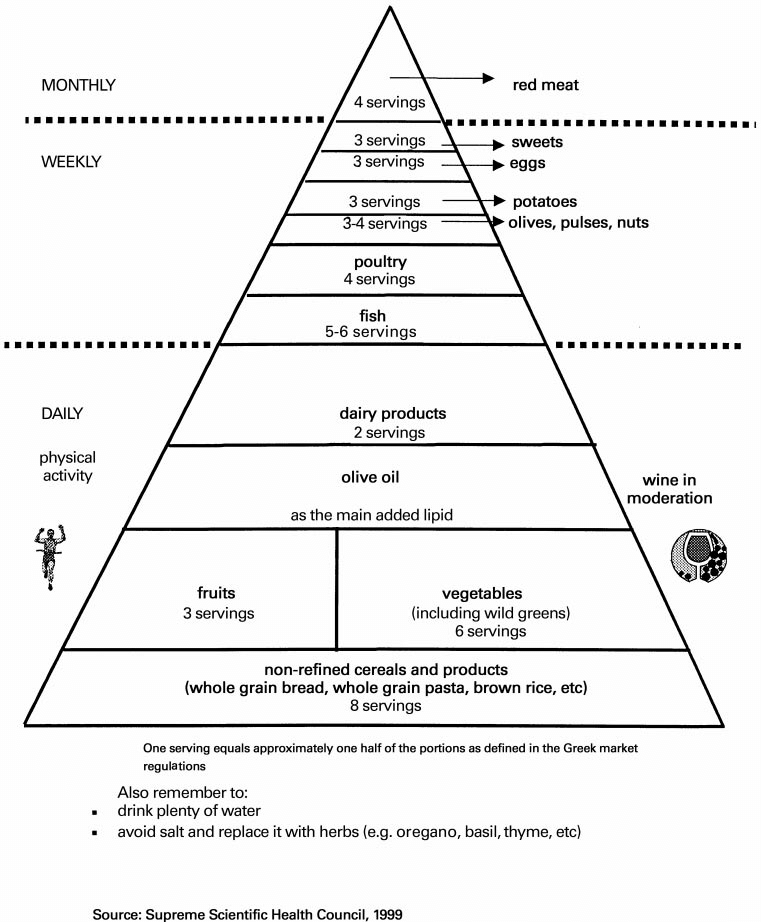
Note the current UK guidelines for fish consumption state 2 servings of fish a week with one being oily fish (4).
Some aspects of the diet may be a challenge for IBS sufferers. If you have symptoms it may be a good idea to try to reduce these and improve food tolerance by taking a good probiotic such as Alflorex which has been scientifically studied for IBS (and medication, if needed); in particular if these symptoms are due to a gut bacterial imbalance, which is true in many IBS cases.
Fruits And Vegetables
Eating a ‘rainbow diet’ of different coloured fruits and vegetables is best. This is because the different colours are due to different phytonutrients, meaning that a variety of different coloured fruits and vegetables will supply a wider range of nutrients to benefit health. (8)
There is plenty of information about how eating from a rainbow of different coloured fruits and vegetables can help your overall health and how this relates to specific foods here (8) and here (9). Additionally, eating a larger number of different fruits and vegetables will increase the diversity of your microbiome, which may help IBS symptoms.
Pulses
One of the recommendations of the Mediterranean diet is to eat pulses. To reduce the FODMAP content of pulses, you can buy tinned pulses and make sure that you rinse them thoroughly prior to consumption, since most of the FODMAPs leach into the liquid in the tin. There is also some helpful information about beans/pulses, especially in relation to gas production and how this could reduce over time as your body gets used to them, here: (6).
A study also found that having one serving a day of beans, peas, chickpeas or lentils can significantly reduce “bad cholesterol” reducing the risk of cardiovascular disease. (7)
In terms of FODMAPs the Monash FODMAP app says:
- Chickpeas:
- 1 serve = 84g (1/2 cup) – contains moderate amounts of GOS – serving sizes over 100g contain large amounts of GOS and should be avoided
- 1/2 serve = 42g (1/4 cup) – low fodmap
- For example, 1 tin is around 260g. Divided into 3 portions is 87g.
- Lentils canned
- 1 serve (1/2 cup) – 46g – low fodmap
Wholegrains
Wholegrains are also recommended. If you are intolerant to the FODMAPs in wheat, there are many options for whole grains such as buckwheat (available as a pasta), brown rice, quinoa and oats (including oat bran). There is also sorghum which is available in a breakfast cereal (gluten free Nutribrex).
Nuts
In a study, those who consumed nuts seven or more times a week, had their cardiovascular disease risk cut by 29% and cancer by 11% compared to those who never ate nuts. (10)
- Almonds: are high in antioxidants vitamin E and magnesium which are good for the heart and skin healing; further they reduce bad cholesterol since they contain mono- and polyunsaturated fats. (10)
- Walnuts: contain omega-3 fats which help with brain health and blood pressure plus according to research, reduce the chances of breast cancer due to being full of antioxidants, phytosterols and other helpful compounds. (10)
- Macadamia nuts: although high in calories (202 calories per ounce) and higher in saturated fat (11), they contain a rare source of omega-7 fatty acids assisting heart health and insulin sensitivity. (10)
- Brazil nuts & cashews: along with macadamia nuts, these are higher in saturated fat, so best not to over consume them. (11)
- Hazelnuts: contain folate (14), which reduces the risk of certain cancers and cardiovascular disease (13)
- Chestnuts: are low in fat since they are starchier (12)
- How many nuts?: Consume about an ounce or 28 grams of nuts per day (about as much as what fits in the palm of your hand), for health benefits, which can be a mixture of nuts or a handful of one kind, like almonds. (10)
What If I Can’t Tolerate Dairy?
If you are unable to tolerate dairy you may need to supplement with calcium. You may also need to supplement with iodine (potassium iodide) which is only available in dairy and fish. I take an iodine supplement on days that I don’t consume fish.
Free Course
I can highly recommend this free course where you can find out more detail about the Mediterranean and Okinawa diets, both of which have favourable impacts on the microbiome – link here: (5).
Further Reading And References
(4) NHS: Fish and shellfish-Eat well, Page last reviewed: 14 November 2022
(5) EIT Food: Understanding Mediterranean and Okinawa Diets on futurelearn.com
(6) The Bean Institute: Beans, Beans, the Magical “Fruit”: The More You Eat the Less You Toot!
(10) Carmen Chai: Why are nuts good for us and how many should we eat? Global News, December 2, 2013
(14) Arlene Semeco: 7 Ways Hazelnuts Benefit Your Health, healthline.com, Updated on July 13, 2023
 IBS Researcher