
Table of Contents
Research Into All Illnesses
Scale Of The Problem Of IBS
Impact Of IBS
Further Reading And References
Research Into All Illnesses
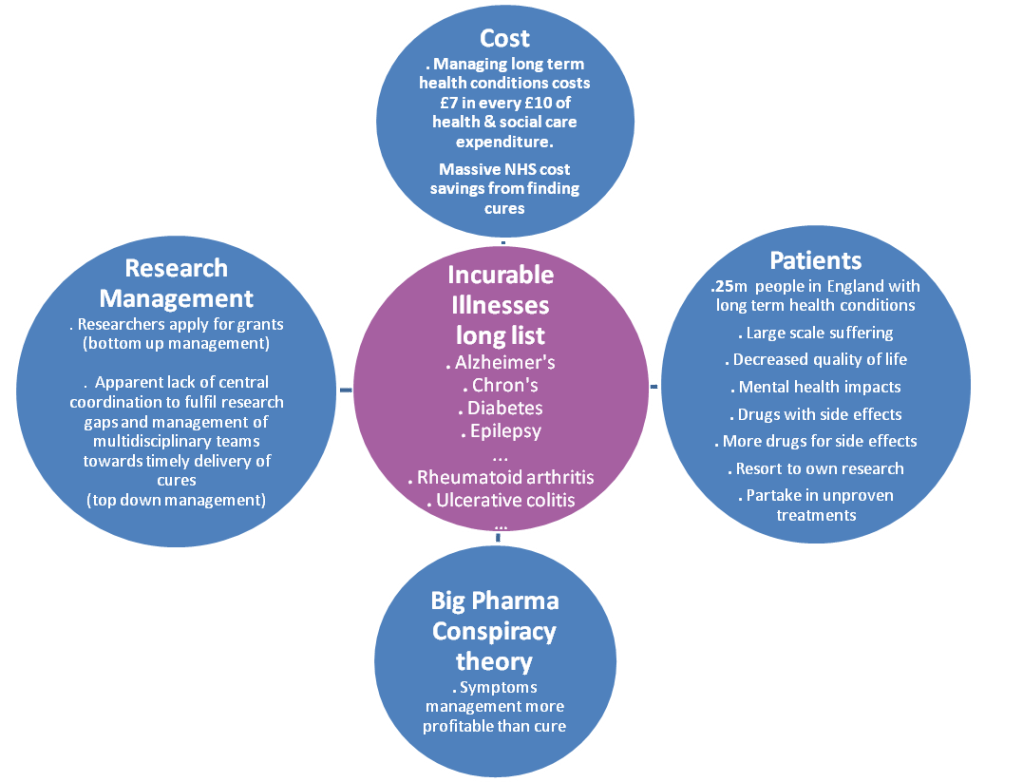
There is an extensive list of incurable illnesses with no end in sight. This is linked with a number of facets and associated problems as outlined below:
Scale Of The Problem Of IBS
- Irritable Bowel Syndrome (IBS) affects up to 1 in 5 people in the UK at some point in their life (7). In a study of 73,076 adults from 33 countries and 6 continents, 40.3% of the subjects were found to have at least one disorder of gut–brain interactions (DGBI) (12)
- IBS accounts for 10% of GP surgery visits (8)
- Heartburn, which, in some cases has links with IBS, affects up to 25% of UK adults (10)
- Food intolerance was estimated to impact 45% of the UK population in 2009 with a 10 fold increase in the previous 25 years (11)
- IBS places substantial financial burdens on healthcare systems. A 2017 study found that the annual cost of managing DGBIs in England is £72.3 million (12). These costs would have increased substantially further since then due to inflation. For example the Bank of England Inflation Calculator suggests a 30% inflationary increase between 2017 and September 2024. Crudely, this increases the £72.3 million figure to around £94 million
Impact Of IBS
- Not life threatening but highly life limiting
- Having to deal day to day with the inconvenience and embarrassment of the condition
- Exacerbated by stress but also causes stress – vicious circle
- More sick days – each IBS sufferer on average has 17 days off work per year due to the condition costing the UK £500 million per annum (9)
- Restricts social life e.g. reduces ability to eat out or go on holiday. Affects being able to meet up with friends and family, since many social occasions revolve around food. May cause social isolation
- May feel unable to leave the house at times due to diarrhoea related to IBS-D or overflow diarrhoea due to IBS-C, so that even basic activities such as going out shopping or even for a walk might seem like an impossibility
- Anxiety around travel due to the need to be close to a toilet
- Anxiety around being in situations where you feel tied such as in the work place, not near a toilet, being in meetings, having customer facing roles, socialising with others
- Impact on mental health
- Hinders ability to make a living
- Restricts work choices e.g. must work from home
- Reduced quality of life
- Feeling demoralised when the condition can’t be helped
- Seeking unproven and expensive treatments which haven’t undergone rigorous testing in the hope of gaining relief
- Resulting in a money making industry to fill the gap
Further Reading And References
1) Basnet, Mohan. (2023). List of Currently Incurable Diseases.
(3) Can we prove big pharma is only treating symptoms? Quora.
(4) Richard Anderson, Pharmaceutical industry gets high on fat profits, BBC NEWS, 6 November 2014
(5) Long Term Conditions, the patients association
(7) NHS Inform: Irritable bowel syndrome (IBS)
(10) Guts UK: Heartburn and Acid Reflux
(11) The Telegraph: ‘Food intolerance’ could afflict half of UK, 15 October 2009
 IBS Researcher